
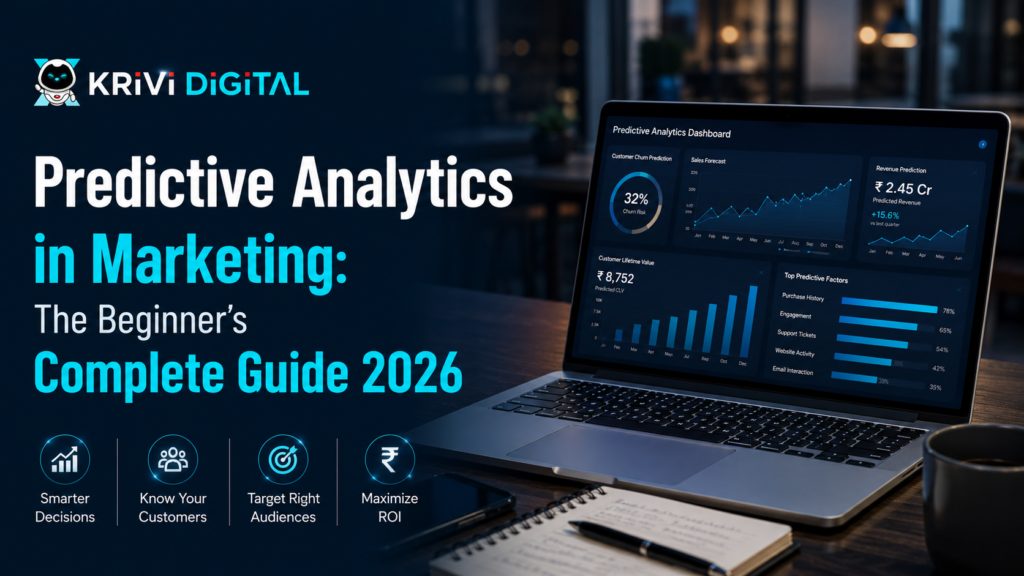
Predictive Analytics in Marketing: The Beginner’s Complete Guide 2026
| Predictive analytics in marketing uses historical data and machine learning to forecast future customer behaviour such as who will buy, who will churn and what content they will engage with. Tools like Google Analytics 4, HubSpot AI and Salesforce Einstein make predictive marketing accessible even for small businesses without data science teams. |
What if you knew which of your leads would buy, three weeks before they did?
What if your email campaign knew exactly when each subscriber was most likely to open and convert and sent itself at that precise moment? What if your Google Ads automatically shifted budget away from audiences unlikely to convert and toward the exact customer segments that would before you even noticed the pattern?
This is predictive analytics in marketing. And in 2026, it is not a luxury reserved for enterprise brands with data science departments. Google Analytics 4 includes predictive features for free. HubSpot’s free CRM uses AI lead scoring. Meta’s Advantage+ does audience prediction automatically.
This is Spoke 6 of our AI-powered digital marketing framework. See our complete AI marketing tools guide for the full toolkit, and our AI for SEO guide for applying predictive principles to search marketing.
What Is Predictive Analytics in Marketing?
Predictive analytics in marketing is the use of historical customer data, statistical algorithms and machine learning to forecast what is likely to happen next so you can take action before it does.
The crystal ball analogy works well here: predictive analytics is like having a crystal ball made of your customer data. It does not predict the future with certainty it assigns probabilities. ‘This customer has an 87% chance of making a purchase in the next 14 days.’ ‘This subscriber has a 73% probability of cancelling their subscription in the next 30 days.’ These probabilities let you act strategically rather than reactively.
The 3 Things That Make Predictive Analytics Work
- Historical data: Your past customer behaviour: what they bought, when, how often, what they looked at before buying
- Machine learning models: Algorithms that identify patterns in this data that humans would never spot manually
- Actionable outputs: Predictions presented in a usable format: audience segments, probability scores, recommended actions
Why Predictive Marketing Is Now Accessible to Every Business
Until 2022, meaningful predictive analytics required a data science team and a business intelligence platform costing ₹5-20 lakh per year. Three developments changed this:
- Google Analytics 4 built predictive AI directly into its free platform. Every website with sufficient traffic data now has Purchase Probability, Churn Probability and Predicted Revenue metrics at zero cost
- HubSpot, Zoho and Salesforce embedded AI lead scoring into their free and starter CRM tiers
- Meta Advantage+ and Google Performance Max automate audience prediction as a built-in campaign feature running predictive marketing automatically without any configuration
How Predictive Analytics Works – The 3-Step Loop
Step 1 – Data Collection
Predictive models learn from your historical data. The more high-quality historical data you have, the more accurate the predictions. GA4 starts building useful predictive data after your website accumulates 1,000+ users who have triggered a conversion event most active Lucknow business websites reach this within 2-4 months.
Step 2 – Pattern Recognition
The AI analyses your historical data to find patterns a human analyst would never spot manually:
- Customers who visit the pricing page 3+ times and then read the case studies page have a 78% conversion rate within 30 days
- Email subscribers who do not open any of the first 5 emails have a 91% probability of never converting
- Customers who purchased in the last 30 days have a 42% chance of buying again within 90 days if re-engaged
Step 3 – Prediction and Action
The model applies what it learned to your current data and assigns probability scores to each customer and lead. These scores trigger automated actions:
- High purchase probability score – triggers a personalised discount email automatically
- High churn probability score – triggers a retention campaign with a special offer
- Low lead score – routes to a nurturing sequence rather than direct sales outreach
5 Ways Predictive Analytics Transforms Marketing
1. Lead Scoring – Know Which Leads to Prioritise
AI lead scoring assigns a numerical score to every lead based on their likelihood to convert. Instead of your sales team treating every enquiry equally, they focus energy on the 20% of leads AI identifies as most likely to become customers.
A coaching institute in Lucknow had 200 monthly enquiries and a 3-person sales team. After implementing HubSpot AI lead scoring, the team focused on the 40 highest-scored leads and improved conversion from 8% to 22% tripling enrolled students without hiring additional staff.
2. Churn Prediction – Retain Customers Before They Leave
Customer retention is 5x cheaper than acquisition. Predictive churn models identify customers showing early warning signs of leaving reduced engagement, missed payments, decreased purchase frequency and trigger automated retention campaigns before the customer actually leaves.
3. Content Personalisation
Predictive personalisation serves different content to different visitors based on their predicted preferences and purchase intent. For Lucknow businesses with content-heavy websites, predictive personalisation ensures that blog readers matching a ‘high purchase intent’ profile see service CTAs, while those in ‘research phase’ see educational content that builds trust first.
4. Ad Budget Allocation
Predictive budget allocation uses historical campaign data to forecast which channels, days, times and audience segments will deliver the best ROI then automatically shifts budget toward those winners. Google’s Performance Max and Smart Bidding do this automatically as a built-in feature at no extra cost.
5. Email Send -Time Optimisation
Mailchimp reports that campaigns using AI send-time optimisation see 23% higher open rates on average. (credit – Mailchimp Send-Time Optimization Data 2026) Instead of sending your entire list at 10am Tuesday, AI sends each subscriber’s email at the exact time they are most likely to engage.
Predictive Analytics Tools – Ranked for Indian Businesses
| Tool | Key Predictive Features | Free Plan | India Price/Mo | Best For |
| Google Analytics 4 | Purchase probability, churn probability, predicted revenue audiences | Yes – full | Free | All businesses with a website start here |
| HubSpot AI CRM | AI lead activity scoring, predictive lead scoring (paid tiers) | Yes – free CRM | Free CRM, ₹1,320+ for predictive | SMBs wanting CRM + predictive together |
| Zoho Analytics (Zia AI) | Trend identification, value forecasting, anomaly detection | 14-day trial | ₹1,150+ | Indian businesses already using Zoho suite |
| Klaviyo AI | CLV prediction, churn risk, next purchase date per customer | Yes – 250 contacts | ₹1,680+ | E-commerce brands, D2C India |
| Salesforce Einstein | Most comprehensive predict any business outcome from your data | No | ₹15,000+ | Enterprise businesses with large datasets |
Setting Up Free Predictive Analytics in GA4 – Step by Step
- Ensure conversion tracking is set up correctly in GA4 – purchase event, lead form submission, call click
- Verify you have at least 1,000 users who triggered your conversion event in the past 28 days
- Go to GA4 – Advertising – Audiences – New Audience – Predictive
- Create these 3 predictive audiences immediately:
- High purchase probability (top 20%) – for remarketing in Google Ads
- High churn probability (top 20%) – for retention email campaigns
- Predicted top spenders – for VIP customer programmes
- Link GA4 to Google Ads and import these audiences into your ad campaigns
- Set up automated audience triggers: when a user enters ‘High Churn’ audience, trigger a re-engagement email via your email platform
Total setup time: 2-3 hours. Ongoing maintenance: zero – GA4 updates the audiences automatically in real time.
Customer Lifetime Value (CLV) Prediction – Why It Matters
CLV prediction is one of the most strategically powerful applications of predictive analytics. If you can predict which customers will spend ₹50,000 with your business over 3 years, you can justify spending ₹5,000 to acquire them through Google Ads even if a competitor only acquiring ₹3,000 CLV customers would find that budget unprofitable.
Simple CLV Formula
Basic CLV = Average Order Value × Purchase Frequency per Year × Customer Lifespan in Years
Example: Lucknow dental clinic: Average treatment value ₹8,000 × 1.5 visits per year × 8 years average patient lifespan = ₹96,000 CLV per patient. This means acquiring a new patient for ₹2,000-3,000 through Google Ads is highly profitable long-term and you can outbid competitors who are not calculating CLV.
Common Mistakes Beginners Make with Predictive Analytics
- Starting without clean data – AI predictions are only as good as the data they train on. Set up accurate conversion tracking in GA4 before expecting meaningful predictions.
- Acting on predictions too early – GA4 needs 1,000+ conversions before predictive metrics activate. Using predictions from insufficient data leads to poor decisions.
- Ignoring model confidence scores – A 52% purchase probability is barely better than a coin flip. Focus action on the top 15-20% probability scores where the model is genuinely confident.
- Not closing the feedback loop – When you take action based on a prediction, track whether it was correct. This feedback improves the model over time.
- Over-relying on predictions – Predictive analytics tells you probabilities, not certainties. Human judgment about strategy, brand and customer experience remains essential.
Frequently Asked Questions
1. What is predictive analytics in marketing in simple terms?
Predictive analytics in marketing uses your past customer data and machine learning to forecast future behaviour like which customers are likely to buy next, which are about to leave and what content they will engage with. It helps you take proactive marketing action instead of reacting after events have already happened.
2. Do I need a data scientist to use predictive analytics?
No in 2026, most predictive analytics tools are designed for marketers without technical backgrounds. Google Analytics 4 predictive audiences, HubSpot AI lead scoring and Meta’s Advantage+ all run automatically without any data science knowledge. For more advanced implementations, Krivi Digital AI marketing service handles the technical setup.
3. Is GA4 predictive analytics really free?
Yes Google Analytics 4 is completely free for standard use and includes predictive metrics (Purchase Probability, Churn Probability, Predicted Revenue) at no cost. The only requirement is having enough conversion data to activate the models minimum 1,000 conversions in the past 28 days from a consistent event.
4. How accurate is predictive analytics for small Indian businesses?
Accuracy improves with data volume. With 1,000-5,000 monthly conversions, GA4 predictive audiences are typically 70-80% accurate. With 10,000+ monthly conversions, accuracy approaches 85-90%. Even at 70% accuracy, acting on predictive segments dramatically outperforms random targeting focusing budget where probability of conversion is highest.
| Want AI-Powered Predictive Marketing for Your Business? Krivi Digital sets up and manages complete predictive analytics systems from GA4 configuration and predictive audience creation to automated email triggers and ad audience optimisation. Explore our AI Digital Marketing service or book a free strategy call. |